Why Your Utilization Is Still High After Paying Down All Your Cards
I still remember the night I sat at my kitchen table, staring at a confirmation screen for a massive payment I’d just made to my biggest credit card. I’d scraped together every extra penny, convinced that this move would finally push my score into the ‘Excellent’ range. But when my credit report updated two weeks later, my heart sank. My utilization was still hovering at a suffocating level, and my score hadn’t budged an inch. I felt betrayed by the very numbers I was trying to improve. It turns out, the math of credit isn’t as simple as ‘pay money, get points.’ You’re likely doing the right thing at the absolute wrong time. [IMAGE_PLACEHOLDER]
The Statement Date Trap You Likely Fell Into
If you are wondering why your credit score flatlined despite your hard work, the answer usually lies in a single date you’ve probably been ignoring. Most of us focus on the ‘Due Date,’ but your credit card company actually reports your balance on the ‘Statement Closing Date.’ I learned this the hard way when I paid off a $2,000 balance on the 15th, only to find out my statement closed on the 14th. The bank told the bureaus I was still maxed out, and I had to wait a full month for the correction to show up.
Does the Credit Bureau Actually Care About My Recent Payment?
It feels like a scam, doesn’t it? You do the work, you pay the debt, and the bureaus act like nothing happened. But they aren’t ignoring you; they are just working on a delay. According to research from FICO, your amounts owed—specifically your revolving utilization—account for roughly 30% of your total score. This means that until that payment is officially reported, your score is essentially frozen in time. Today, I’m going to show you how to beat this lag, including the 15/15 rule and even a few strategies for lowering your utilization overnight that don’t require another cent of your money. Have you ever felt like you were screaming into a void after paying down your cards and seeing no results?
Why Your Score Needs a ‘Cool Down’ Period
It’s not just about the statement date; it’s about the ‘mid-cycle’ reporting habits of different lenders. Some banks are faster than others, and if you are carrying balances on multiple cards, the ‘total utilization’ won’t look healthy until every single one of them has hit their reporting window. This is why mastering debt management requires a bit of strategic patience. We’re going to break down exactly when to time your payments so you never have to wait 30 days for credit again.You have to stop thinking like a consumer and start thinking like a data provider. To the bureaus, you aren’t a person with a story; you are a spreadsheet. If that spreadsheet says you’re maxed out on the 14th, you’re high risk—period. Changing your score requires you to change the data before it ever hits their servers. First, you need to execute the 15/15 rule flawlessly. This isn’t just about paying more; it’s about paying smarter. By splitting your monthly payment into two chunks—one 15 days before the statement date and one 3 days before—you ensure that the balance reported is always at its lowest. I used to think that as long as I paid by the due date, I was doing fine. But after I started this method, I saw my score skyrocket because the logic behind the 15/15 rule for credit card payments is the closest thing to a legal cheat code. 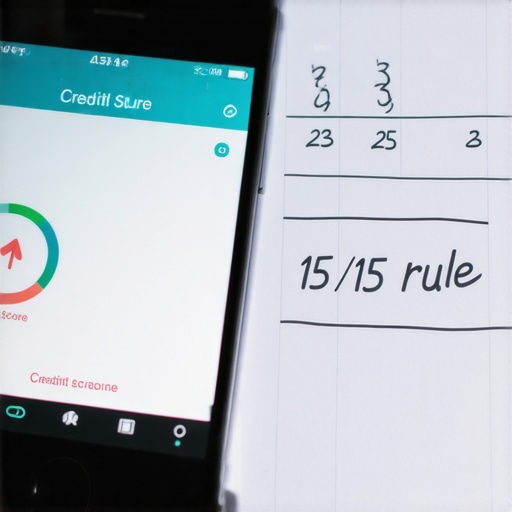
Adopt the 15/15 Rule to Trick the Reporting Cycle
The 15/15 rule works because it lowers your average daily balance and guarantees that your reported utilization is negligible. It’s essentially a double-tap on your debt that the algorithm can’t ignore. If you are struggling with high interest, this also helps you stop paying interest on your interest because you’re reducing the principal faster than the bank can calculate the next month’s charge. I remember the first month I tried this; my score jumped 22 points simply because the reported balance was $50 instead of $1,200, even though I spent the same amount of money overall.
Why the Ghost Account Trick Actually Works
If you can’t pay down the debt fast enough, you need to artificially inflate your available credit. I used what I call the ghost account trick for lowering your utilization overnight. This involves becoming an authorized user on a family member’s long-standing, low-balance account. You don’t even need the physical card. The history of that account ‘haunts’ your report in the best way possible, adding years of age and thousands in available credit. It’s one of the most effective credit repair tips to boost your score today without needing a bank’s approval or a hard inquiry.
Clean Up the Technical Trash on Your Report
Sometimes the ‘meat’ of the problem isn’t your spending, but the paperwork. I once found three different versions of my name and two old addresses on my TransUnion report. It seems small, but lenders see multiple aliases or frequent moves as a red flag for identity instability. You need to follow the step-by-step way to handle a wrong name on your report immediately. Once those are gone, your report looks ‘cleaner’ to the automated algorithms that determine your creditworthiness.
Force the Bureaus to Prove Every Negative Entry
Don’t just ask them to remove a late payment; make them prove they have the right to keep it there. This is where the method of verification letter comes in. When you send this, you aren’t just disputing the debt; you are demanding to see the original contract or the digital log of the reporting. If they can’t produce it within 30 days, they have to delete it. This is a core part of mastering credit building because it shifts the burden of proof from you back to the multibillion-dollar bureaus. I once managed to wipe an old $400 medical bill this way simply because the collection agency lost the original paperwork during a merger. It proved that effective credit repair techniques are often more about persistence and timing than having a fat bank account.
Most gurus will tell you to cut up your cards and close the accounts the moment the balance hits zero. In my experience, that is the fastest way to tank your score. One of the biggest top credit repair myths busted by experts in 2025 is the idea that ‘closed’ means ‘clean.’ When you shut down an old account, you aren’t just getting rid of a piece of plastic; you are deleting history. FICO data confirms that the ‘length of credit history’ accounts for 15% of your total score. By closing that ten-year-old card, you’re essentially telling the algorithm you’re a much less experienced borrower than you actually are.
Keep Your Old Accounts Open Even if You Hate the Bank
I’ve seen dozens of people work tirelessly on how to repair credit fast only to see their progress vanish because they wanted a ‘fresh start.’ This is why why your FICO score dips when you close an unused account is a topic I repeat until I’m blue in the face. If the card has no annual fee, keep it in a sock drawer and use it for a small $5 subscription once a month. This keeps the line active and preserves your average age of accounts. 
What Happens When a Collector Restarts Your Seven-Year Clock?
This is the most dangerous ‘Oops’ factor in the entire industry. You might get a call from a collector about a debt that is six years old. They’ll be polite, maybe even friendly, and ask if you can just send ‘five or ten dollars’ to show good faith. Do not do it. In many states, that tiny payment acts as a legal acknowledgment of the debt, which can restart the statute of limitations. Suddenly, a debt that was about to fall off your report is legally revived for another seven years. It is one of the most dirty tactics debt collectors use to restart the clock, and once you’ve paid, it is incredibly hard to undo.
The Critical Difference Between Settlement and Management
Another nuance people miss is the distinction between debt settlement and a structured management plan. Settlement often involves intentionally stopping payments to ‘force’ a negotiation, which destroys your score in the process. Conversely, why debt management plans are different from risky settlement programs is that they prioritize your credit health while lowering interest rates. You need to look for credit counseling insights to avoid common pitfalls before you sign anything. A mistake here can leave you with a ‘settled for less than full balance’ notation that scares off mortgage lenders for years. Have you ever fallen into the trap of closing an account or making a ‘good faith’ payment only to see your score drop? Let me know in the comments below.
Think Twice Before You Ask for a Professional’s Help
You might be tempted to hire a high-priced firm, but there is a reason why you don’t need a credit repair lawyer for simple disputes. Most of the ‘heavy lifting’ can be done with the right letters and a bit of organization. By using effective credit repair tips to boost your score, you can often achieve better results than a company that is simply sending automated templates. It’s about being precise and understanding the laws like the Fair Credit Reporting Act (FCRA). Remember, your credit is a marathon, not a sprint, and the nuances are what separate the 700s from the 800s.
Once you’ve successfully scrubbed the errors and optimized your payment dates, the transition from ‘repairing’ to ‘maintaining’ requires a different set of muscles. I personally use a simple custom spreadsheet to track my ‘Debt-to-Income’ (DTI) and ‘Utilization’ trends on the 1st of every month. I don’t rely on the flashy apps that give you a ‘simulated’ score. Instead, I go straight to the source. You should be getting your credit report for free without hidden fees through the federally mandated AnnualCreditReport.com site at least once every four months, rotating through the three bureaus to keep a year-round watch.
Scale Your Score Without Spending an Extra Cent
Maintenance is where most people get bored and fail. They stop checking the details until they need a mortgage, only to find a surprise collection from a forgotten utility bill. To reach the upper echelons of credit, you have to realize that having a ‘clean’ report is only the baseline. You want to start getting your credit score to 800 and beyond by letting time and strategic limits do the work. The industry is shifting toward ‘trended data’ models like FICO 10T and VantageScore 4.0. These models don’t just look at what you owe today; they look at whether your balances have been rising or falling over the last 24 months. Consumer advocate Clark Howard often notes that ‘your credit score is a snapshot in time, but your credit history is a movie.’ You want your movie to look like a steady, downward trend in debt and an upward trend in available credit lines.

How do I maintain an elite credit score over time?
The secret isn’t checking your score every morning; it’s about smart debt management practices for maintaining financial health that prevent surprises from hitting your file. I set a ‘hard limit’ on my utilization at 5%—not the 30% that the banks suggest. If I see a card creep past that, I pay it immediately regardless of the due date. I also employ a few credit building hacks like the ‘automatic limit bump.’ Every six months, I use the exact script for requesting a credit limit increase to grow my available credit without a hard inquiry. This keeps my utilization naturally low even if I spend a bit more on a vacation. If you ever slip up with a late payment, don’t panic; use the simple script for getting a goodwill deletion on late payments before the mark becomes permanent. My prediction? In the next few years, things like rent and utility payments will become standard for everyone, making it even easier to maintain a high score if you stay organized. My challenge to you today: call your primary credit card company right now and use that script to ask for a limit increase. It’s a five-minute move that can shift your score overnight.
When I first started this journey, I thought I could outsmart the system with just one or two big moves. I quickly realized that credit is more of a living ecosystem than a simple math problem. #IMAGE_PLACEHOLDER_E#
The Hardest Lesson I Learned About the Reporting Cycle
The most painful realization I had was that the bureaus don’t care about your intent; they only care about the timestamp. You can have the best intentions in the world, but if your data hits the server at the wrong moment, you’re stuck in a low-score loop. I learned that you have to be your own advocate because the systems are designed for speed, not accuracy. If you don’t double-check every line, you’re essentially letting a machine decide your financial worth. It’s also vital to avoid the most common credit repair mistakes like disputing facts that are actually correct, which can lead to your file being flagged as frivolous. Lastly, remember that your score is a reflection of your habits, not your character. Don’t let a three-digit number define your self-worth while you work through the process.
The Resources That Actually Moved the Needle
I didn’t get to an 800 score by guessing. I relied on a few core pillars that I still use today. First, I highly suggest studying the ultimate credit repair blueprint for 2025 to stay ahead of the new FICO 10T modeling. For those struggling with high-interest balances, looking into credit counseling secrets for smarter debt management in 2025 can provide a structured path that doesn’t involve the risks of predatory settlement companies. I also keep a physical folder of every ‘Letter of Deletion’ and ‘Account Closed’ notice I’ve ever received. In the digital age, having that paper trail is your only real shield if an old error suddenly reappears three years down the line.
Take Back Control of Your Financial Narrative
You now have the tools to stop being a passive participant in your financial life. Whether you are using the 15/15 rule or executing a precision dispute, every action you take is a vote for your future self. Successful credit repair isn’t about magic; it’s about the relentless application of the right strategy at the right time. Don’t wait for the ‘perfect’ time to start cleaning up your report. The best time was five years ago; the second best time is right now. You have the knowledge, you have the scripts, and you have the blueprint. Now, go execute. Have you ever noticed your score stall even after you made a massive payment? Drop a comment below and let’s troubleshoot it together.